01 / NETWORK SIMULATION
Follow a packet. Understand the system.
TypeScript · Discrete-event simulationInteractive
SIMULATION / DATA / EXPLORABLE WORLDS
Six projects, built to be explored.
Open an application or inspect the engineering behind it.
01 / NETWORK SIMULATION
Follow a packet. Understand the system.
02 / GEOSPATIAL / 3D
A city you can read at street level.
03 / GEOSPATIAL / SCENARIOS
One real city. More possible futures.
04 / CREATIVE GRAPHICS
Step beyond the edge of a painting.
05 / NUMERICAL SIMULATION
The same laws. Radically different futures.
06 / DATA INTERFACES
A race, from several angles.
THE INTERACTIVE WORKBENCH
Explore the actual application.
One project at a time, right here.
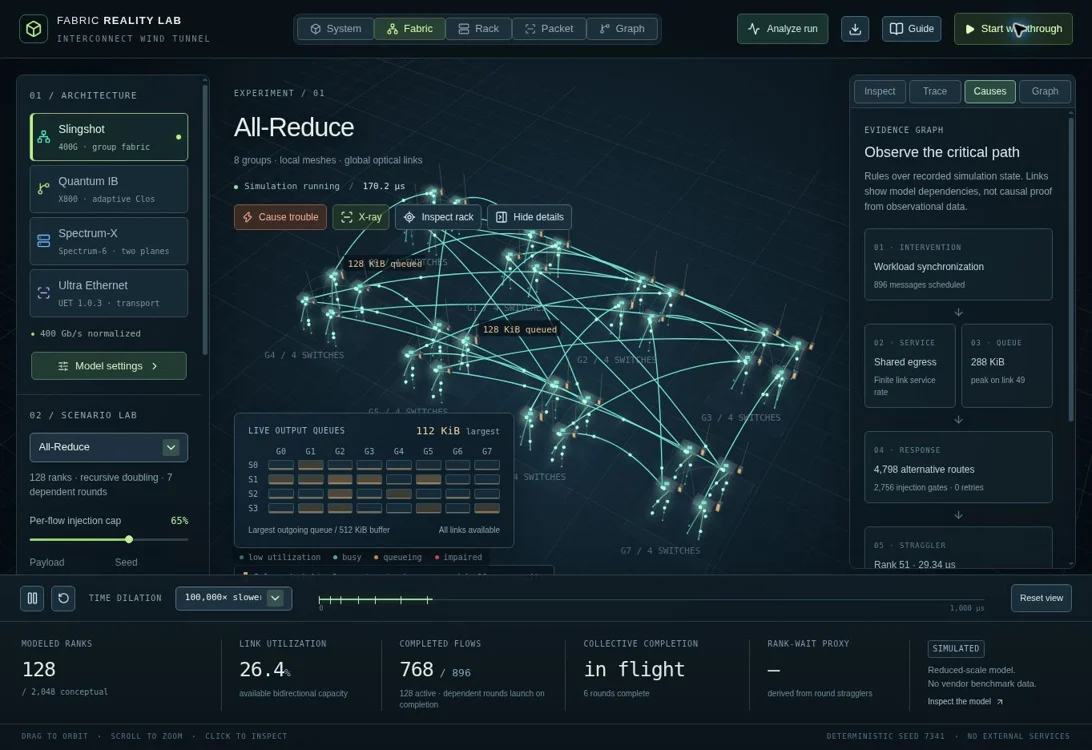
Start the guided tour, then compare architectures and inspect a packet.
Opens here · Loads only when you launch itChoose an image to launch, or a project title for technical details. 3D views require WebGL. Each project opens on its own; closing it stops its rendering and background work.
WHAT IT DOES
An interactive HPC and AI network simulator. Compare fabric architectures, inspect queues, and trace how a collective workload moves through the network.
INSIDE THE BUILD
128 explicit ranks and 32 access switches across three modeled fabric architectures.
Deterministic packet scheduling, bounded queues, and full-duplex link serialization.
Paired architecture replay, round waterfalls, traffic matrices, and latency distributions.
A reduced, explainable network model—not a vendor performance benchmark. Model assumptions are exposed in the lab. Each project is deployed independently from its own GitHub repository.
ENGINEERING NOTES
Simulation, visualization, and data-heavy interfaces share a problem: the user needs to see what a system is doing—and understand what the model can actually tell them.
These projects make that behavior inspectable through controls, comparisons, and explicit model boundaries. The source links go straight to the implementation.
Project descriptions are grounded in implementation source. Each application includes its own model boundaries; each live project is maintained in its own repository.